
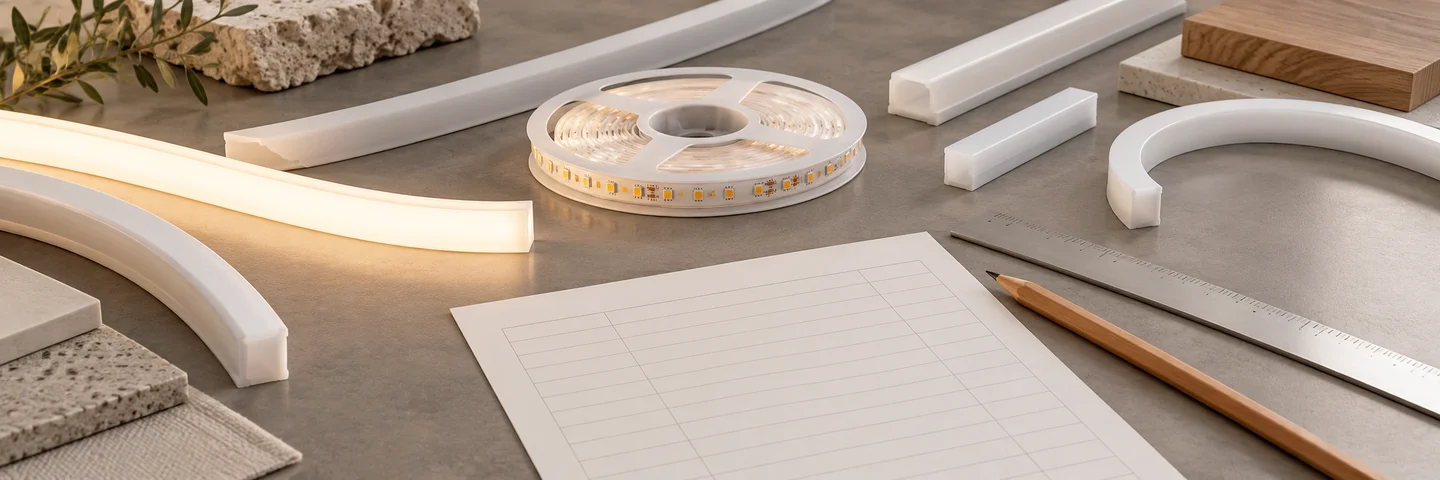
LED strip power consumption belongs on the purchase schedule beside the exact configuration, cut lengths and quantity. A price per metre without those details makes it difficult to compare suppliers or reserve the right power arrangement. For an AlisterTech enquiry, send the lighting schedule and the profile drawing together so the LED source, silicone housing and end connections can be reviewed as one supply requirement.
Start with the configuration being purchased
Use the wattage per metre for the exact strip or finished lighting configuration. Keep its voltage, colour option, control mode and document revision attached to that figure. A reel length, LED package name or profile dimension does not establish its power consumption.
An empty silicone tube has no electrical load of its own. A separately selected LED strip supplies the light source; LED Neon Flex includes an LED source in the finished lighting product. State which of these you want quoted. Otherwise, a housing-only price and a finished-light price can look like competing offers when they cover different products.
For colour-changing or tunable-white products, ask which operating condition the quoted power describes. Single-channel operation, mixed white and a manufacturer's defined maximum condition must not be treated as interchangeable figures. Use the supplier's documented limits rather than adding channel ratings without confirmation.
Build a load schedule your supplier can quote
List each distinct configuration on its own row. Repeat the row when voltage, light output, connection arrangement or operating condition changes. This also makes it easier to trace an approved sample to the production order.
| Schedule field | What to enter | Why it changes the quotation |
|---|---|---|
| Configuration reference | Exact product reference and document revision | Keeps the power figure tied to the selected product |
| Segment length and count | Individual illuminated lengths, quantities and connection allowances | Separates supplied sections from the overall project length |
| Power basis | W/m, voltage and stated operating condition | Allows like-for-like load comparison |
| Calculated strip load | W/m × illuminated metres × quantity | Establishes the nominal light-source load for that row |
| Profile and ends | Section drawing, cable exit and mounting detail | Defines the mechanical supply and assembly scope |
| Equipment responsibility | Who selects and supplies the driver, controller and wiring | Prevents an assumed equipment package from entering the order |
Where sections must arrive identified by room, display or installation position, add a location reference to the custom-length cut list. A total number of metres alone does not describe how many finished sections or end connections are needed.
Keep watts, energy use and supply capacity separate
For a single documented configuration, the nominal strip-load calculation is:
Strip load in watts = specified W/m × illuminated length in metres × number of sections.
Here is a calculation example using invented planning values, not an AlisterTech product specification. If a strip were specified at 10 W/m and an order contained twelve 1.5 m sections, its calculated strip load would be 180 W. Running that load for eight hours would represent 1.44 kWh at the strip-load boundary: 180 × 8 ÷ 1,000.
Actual electricity consumption at the supply input also depends on driver losses, control behaviour, standby consumption and operating conditions. Do not present a strip-load calculation as a measured mains-energy result. For a running-cost estimate, use the relevant input-energy figure, operating hours and local electricity tariff. The U.S. Energy Information Administration explains the relationship between watts and kilowatt-hours.
The calculated load is also different from the driver's nameplate capacity. A larger capacity rating does not mean the strip constantly consumes that rating. Driver selection must account for the specified output type, voltage, operating limits, ambient conditions and the manufacturer's loading guidance. Our constant-voltage and constant-current selection guide covers that distinction; this schedule is not a wiring design.
Resolve the physical sections before approving the order
AlisterTech's manufacturing information shows silicone profile processing and assembly context. For a finished-light enquiry, the useful next step is to connect the electrical schedule to the section drawing: where each length finishes, which face emits light, where the cable exits and how the profile is retained.
The same nominal total length can involve very different quantities of end treatments and connection points. If an existing section does not fit, provide the available space and strip dimensions for a custom silicone extrusion review. Request confirmation of what is included in the quoted lighting sections and what remains with the installer or equipment supplier.
Before placing a production order, bring the approved configuration reference, final cut list and connection drawing into the same document set. Review a sample against that set. If a long run needs a different feed arrangement, resolve it with the responsible electrical designer and the voltage-drop planning requirements; do not compensate by changing the strip's stated W/m.
Send a load schedule with your quotation request
Send the exact configuration if already selected, individual lengths and quantities, supply voltage, operating mode, profile section, cable-exit preference and destination. Identify any existing driver or controller by its full reference. If power data is still missing, mark it as a value to confirm before approval.
AlisterTech can review the silicone profile and lighting supply scope against those inputs. Ask for the relevant configuration information through Technical Resources and attach your schedule to a lighting quotation request. This gives the quotation a defined product and assembly basis instead of an unexplained price per metre.
Frequently Asked Questions
How do I estimate power consumption from the exact strip configuration?
Multiply the specified watts per metre by the illuminated length and number of sections using that exact configuration. Keep the voltage and stated operating mode with the result. If the supplier has not confirmed those values, request the configuration document before finalising the load.
How do operating hours affect the running cost of an LED strip installation?
Energy in kWh equals power in watts multiplied by operating hours, divided by 1,000. Multiply the relevant input-energy figure by the local electricity tariff to estimate cost. A strip-load calculation alone excludes driver losses and other equipment consumption.
Should a quoted power figure identify the length and colour-control mode?
Yes. It should identify the exact configuration, whether the figure is per metre or for a complete section, the voltage and the operating condition. For multi-channel products, ask what the figure means for the selected mode and the documented maximum condition.
Which load details should I provide when asking for finished lighting sections?
Provide the configuration reference, voltage, individual lengths, quantities, control requirements, profile section and cable exits. Identify who supplies the driver and controller. Include a drawing or cut list so the electrical schedule can be matched to the physical sections.
Does an empty silicone LED tube have a wattage rating?
The empty housing is not a powered light source and has no operating wattage of its own. Power consumption belongs to the selected LED strip or finished lighting configuration. Ask separately about the housing's fit and its suitability for the proposed assembly.