
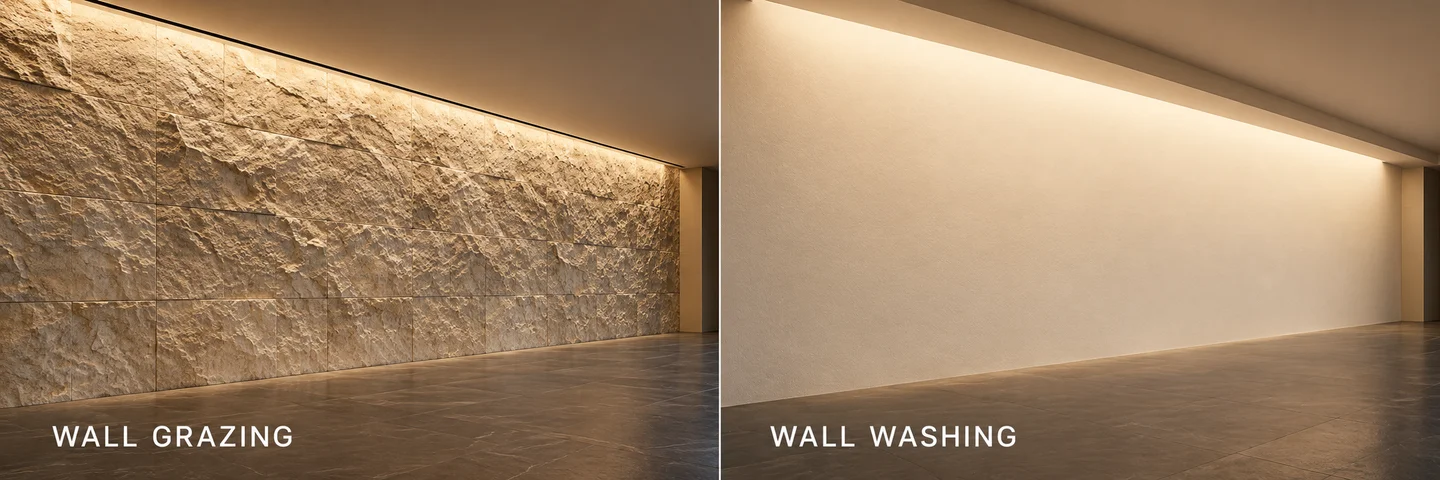
The wall grazing vs wall washing decision should be settled before choosing a silicone light profile. Does the buyer want to reveal the relief in a stone wall, or light a smooth surface evenly? The answer changes the position of the light, the required distribution and the detail your supplier needs to quote. A continuous luminous strip does not, by itself, establish either result.
For a custom lighting assembly, send AlisterTech the wall section and intended appearance together. We can review the silicone profile, strip space, visible face and end connections against that brief. If the design needs a specialised wall-wash optic or verified photometric performance, identify that requirement before selecting the silicone components.
Decide What the Wall Should Look Like
Wall grazing lighting places light close to the surface to bring out texture through highlights and shadows. Wall washing aims for a more even field with reduced shadows across the wall. This distinction is described in Nora Lighting’s explanation of wall lighting techniques. It is a starting point for the design brief, rather than a fixed installation distance.
Show a representative wall finish. Deep joints, uneven stone and projecting details behave differently from painted plaster. A reference photograph can explain your preference, but the sample must use the actual finish and proposed lighting arrangement. For a broader layout discussion, see our architectural linear lighting application guide.
| Purchasing decision | Wall grazing | Wall washing |
|---|---|---|
| Desired appearance | Relief and texture become prominent | A smoother, more even lit surface |
| Detail to send | Surface relief, joints and position of the light relative to the wall | Wall height, finish, available mounting position and intended coverage |
| Sample concern | Excessive shadows, visible emitters and irregularity at joints | Hot spots, dark zones, scalloping and glare |
| Evidence to request | Representative wall mock-up and the selected source/profile detail | Appropriate optical information and any required photometric evidence for the proposed assembly |
| Silicone component review | Source clearance, light face, route and end detail | The same mechanical checks, plus confirmation that the complete optical arrangement suits the brief |
Keep the Wall Effect Separate From the Product Name
A silicone tube is an empty housing for a separately selected strip. LED neon flex includes the light source. Neither name guarantees a uniform wash over a specified wall height. A diffuser that produces a smooth visible line can still create an unwanted pattern on the wall.
Choose LED silicone tubes when the order is for the housing and the strip is being selected separately. Review LED Neon Flex when the quotation needs to define the finished lighting configuration. Use custom silicone extrusion when the section, retention feature or internal space must change. Tell us which components will be provided by your luminaire maker or installer.
The choice also differs from direct vs indirect LED lighting: hiding the source and controlling the wall appearance are separate decisions. Both need to be visible in the installation drawing.
Turn the Installation Section Into a Useful Quotation
Before sending only a desired profile width, include the wall height and material, recess opening, mounting surface, available depth and cable access. Mark the emitting face and show where people will view the installation. For a curved route, identify the required bending plane and ask for the permitted limits of the selected section.
Break the run into actual ordered lengths. Show corners, joins, cable exits and service access; a shadow at a connection can matter as much as the appearance halfway along a straight run. List the required colour or white-light appearance and control requirements separately from the mechanical section. Electrical values must come from the exact quoted configuration.
For repeat installations, identify the recurring section and the exceptions. This lets the quotation distinguish standard lengths from special ends instead of treating every run as one interchangeable item.
What AlisterTech Can Review With You
Our manufacturing information covers silicone profile processing and assembly context. A drawing, section sketch or sample gives us a basis to discuss profile geometry, LED strip clearance and connections. These are useful supply decisions for a lighting manufacturer or project buyer developing the finished detail.
Keep the agreed supply list explicit: empty silicone profile, selected lighting assembly or custom profile development. Supporting documentation depends on the chosen product and project requirement. Request applicable files through Technical Resources and identify any required photometric report before approving the order. A processing photograph is evidence of the activity shown, rather than proof of a particular wall-lighting result.
Approve a Wall Sample Before Repeating the Detail
Use a representative wall section with the intended finish, source, silicone profile and mounting position. Keep operating settings and camera exposure consistent when comparing options. Review the wall from the intended standing or seated position and include a joint or end connection in the sample.
Record what was approved: texture emphasis or evenness, visible dots, glare, shadows, colour appearance and access for the cable. If the project has measured criteria, identify the method and acceptance values in the lighting specification; photographs alone cannot establish them. Keep the approved configuration with the order so that changing the source or profile triggers a review.
Frequently Asked Questions
What is the difference between wall grazing and wall washing?
Grazing emphasises surface relief with light close to the wall. Washing aims for a more even illuminated surface with fewer shadows. Select the effect around the actual wall material and proposed lighting arrangement.
Can LED neon flex guarantee an even wall wash?
No. A continuous visible light line does not establish the distribution over a wall. Review the complete source, optical arrangement, mounting position and wall sample, with any photometric evidence the project requires.
How far should the light be from the wall?
There is no single distance suitable for every source, wall height, finish and optical arrangement. Show the available position in your section drawing and confirm the proposed detail with an appropriate sample or lighting assessment.
Can AlisterTech supply only the silicone profile?
Yes, a housing-only requirement can be reviewed separately from a finished lighting assembly. Send the strip dimensions, section, visible face, route, connections and quantity so that the quotation identifies the intended supply scope.
What should I send to request a quotation for a custom wall-lighting detail?
Send a wall section, finish or reference image, desired grazing or washing appearance, available profile space, light-source requirement, segment lengths, ends and quantity. Identify components supplied by others and any documentation or measured performance needed for approval.