
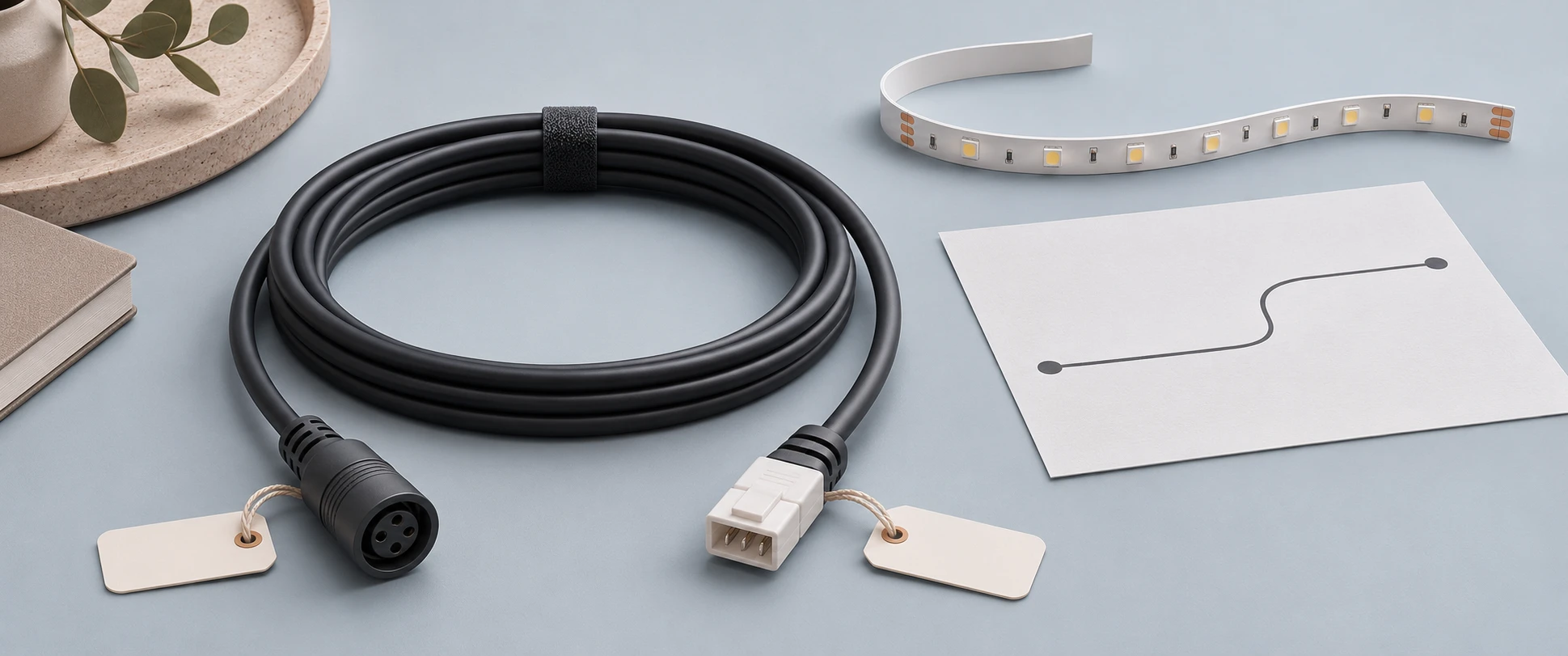
An LED strip extension cable is not specified by length alone. The two ends may connect to different products, and the cable may carry power, multiple lighting channels or a control signal. A useful enquiry identifies the complete link before the supplier prices the lead.
Begin with a simple route sketch showing the two mating products. Label the cable ends A and B on the sketch and attach close-up photographs of each interface. Do not assume that visually similar housings share the same contact assignment or electrical suitability.
Write a Two-End Schedule
For each end, record the mating product reference, connector view, contact count and documented assignment. Include a side view where a latch, seal or mounting surface affects fit. If an existing lead must be copied, identify the sample and state what may change.
The LED accessories range is a starting point for discussing available connection formats. A listed connector photograph does not confirm every mating part or a complete extension assembly. For a bare strip end, use the connection guide to identify the relevant source information.
| Order field | Define it before the cable is made |
|---|---|
| End A and End B | Mating references, contact assignment and orientation |
| Finished length | The measurement endpoints, including how connectors are treated |
| Electrical role | The selected source, equipment and applicable circuit requirements |
| Physical route | Available space, lead exits, movement and installation access |
| Identification | Labels, segment references and quantity by cable type |
Wire colour should not replace the circuit reference. Ask for the assignment of each contact on the proposed assembly, tied to the mating products. Keep any drawing or accepted sample with the order so the same reference can be used during receiving.
Agree What “Length” Includes
A dimension between connector tips is different from exposed cable length or a dimension measured from a housing exit. Mark the intended endpoints on a sketch rather than letting each supplier use a different convention.
Show the installed route separately from the finished cable dimension. The route may need room for access, connector engagement or an agreed service allowance. Do not add an arbitrary allowance without checking the actual assembly. Tie each cable to the relevant lighting section in the cut-list schedule.
If multiple lengths or end combinations are required, put them on separate schedule lines. That makes a mixed order easier to quote, pack and identify than a single instruction to supply assorted extensions.
Separate a Cable Quote From Electrical Approval
An extension changes the path between products. Its suitability depends on the circuit, load, route and connected equipment. Do not select a conductor solely from the strip voltage or copy an allowable length from another product.
Provide the source and power or controller references, the intended connection arrangement and any applicable specification. Ask who will confirm the conductor and interface requirements for the complete installation. The voltage-drop planning guide covers that separate review; this order schedule is not a cable-sizing calculation.
For RGB or controlled products, confirm the actual channel or signal arrangement. Matching the number of contacts does not establish a matching pin assignment. The control-protocol guide helps identify the equipment information to include.
Ask AlisterTech for a Defined Assembly Scope
AlisterTech supplies lighting accessories alongside LED strips, silicone profiles and finished lighting formats. Send both mating references and the route so the requested lead can be reviewed with the proposed lighting assembly. Availability, cable construction and termination details must be confirmed in the quotation rather than assumed from this guide.
For a lead leaving a profile, include the section and cable-exit direction. A change to the surrounding housing can be discussed through custom silicone extrusion. Keep that mechanical decision separate from approval of the cable's electrical construction.
The manufacturing page shows assembly contexts; technical resources provide the starting point for supporting references. Ask the quotation to state whether it includes the finished lead, connectors, mating parts and any assembly work. Then agree the sample, identification and packing requirements before repeat supply.
Frequently Asked Questions
What information defines an LED strip extension cable?
Identify both mating ends, contact assignment, finished-length convention, circuit requirements, route and quantity. Length and connector appearance alone are insufficient.
Can I specify the lead using wire colours alone?
No. Tie each contact to a documented circuit or mating-product reference, and confirm the proposed assembly’s assignment.
Is the cable length the same as the lighting route length?
Not necessarily. Define the cable’s measurement endpoints and review the installed route, access and any agreed allowance separately.
Does a matching pin count prove compatibility?
No. Mechanical fit, orientation, contact assignment and applicable electrical requirements must also match.
Can AlisterTech review an existing cable sample?
Submit the sample reference, mating-product details and requested changes. Ask the quotation to confirm the available assembly and any information still required before approval.