
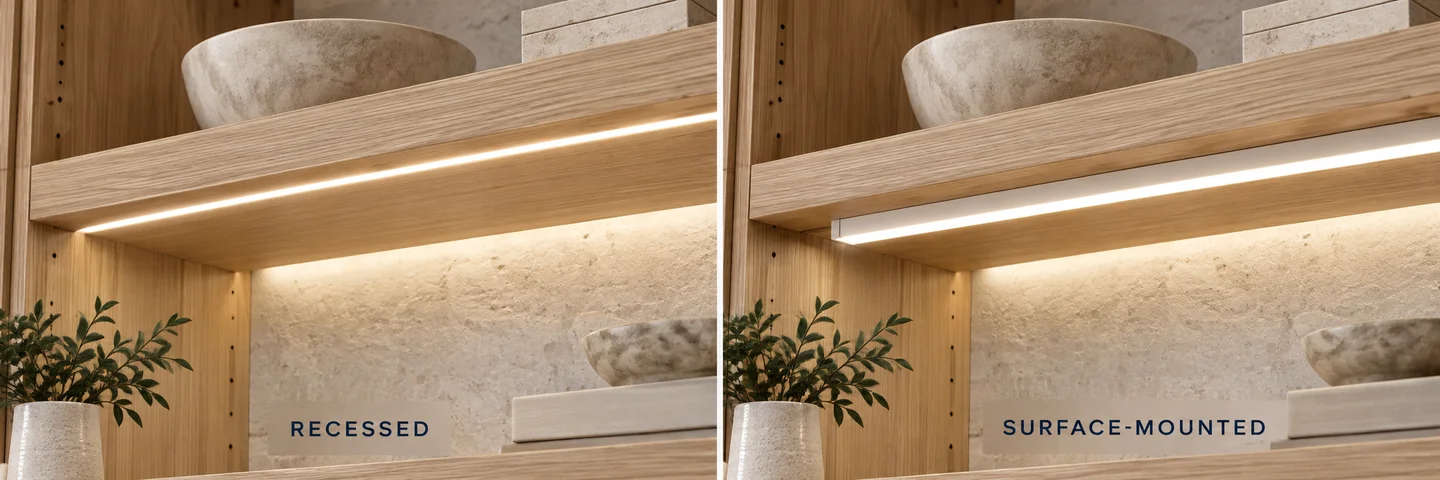
Recessed LED strip lighting needs more than a strip that fits inside a slot. The finished opening, light face, retention detail and cable exit have to work together. Before a joinery maker routes a repeated groove, send AlisterTech the section and the exact strip reference. We can review an existing silicone housing or discuss a custom profile around the space you actually have.
A flush line is a construction decision as well as a lighting decision. A shallow recess may accept the straight body but leave no room for its ends. A wider opening may expose an unwanted gap. Resolve that interface with a representative sample before committing the surrounding material.
Recessed or surface-mounted: what changes in the purchase?
In a recessed arrangement, some or all of the lighting body sits within the surrounding construction. In a surface-mounted arrangement, the body is fixed onto it. Neither description establishes the material, the light distribution or the supplied components. A recessed product can emit directly into the space; an indirect wash depends on where the light travels after leaving it.
| Purchase decision | Recessed detail | Surface-mounted detail |
|---|---|---|
| Installation envelope | Opening, depth and finished edges constrain the assembly | Body projection and visible fixings become part of the appearance |
| Retention | Confirm how the section is held and later removed | Confirm support, substrate and the chosen fixing method |
| Light face | Decide whether it is flush, set back or deliberately proud | Decide which parts of the housing should remain visible |
| Connections | Reserve end and cable clearance beyond the straight body | Identify visible cable routes and access to terminations |
| Repeated production | Match the approved profile to the finished groove | Match the approved support and body to the mounting surface |
Industry catalogues also distinguish these mounting arrangements: the KLUS downloads library provides separate surface and recessed profile models. Its rigid-profile products are separate from an AlisterTech silicone component quotation; their dimensions and fixing instructions should not be transferred to a different assembly.
Give us the finished groove, not only the nominal profile size
Show a cross-section after the decorative finish, lining or retaining part is included. Mark which dimensions are fixed and which can change. Include the opening width, available depth, visible edge and the surface that supports the lighting. Add any restriction on the direction from which a profile can be inserted or removed.
Then identify the LED strip: PCB width, component height and the intended connection. Outside profile fit and internal strip fit are separate checks. A housing can fit the groove while its internal channel conflicts with the strip or a connector. Use the strip-to-silicone-profile fit guide for that separate relationship.
If the groove is already machined, send a measured section or a physical reference piece. If it is still being designed, identify the dimensions that the joinery maker can revise. Avoid cutting every production part around an unapproved image or a nominal size alone. Critical dimensions and tolerances belong on the agreed development basis.
Choose a silicone component or a finished lighting section
An empty silicone tube or profile provides a housing or diffusing body for a separately selected source. It is not powered lighting by itself. Start here when your team is specifying and assembling the strip separately.
A finished LED Neon Flex configuration includes the source as part of the lighting product. Its exact outside section, visible face, bend orientation and ends still need to suit the recess. Do not select it from an illuminated photograph without checking those interfaces.
For a fixed opening that cannot accommodate an available section, custom silicone extrusion provides another route to review. AlisterTech's published development scope covers profile geometry, internal clearance, light direction and connection requirements from drawings or samples. A new geometry needs its own agreed design and sample basis; it is not a promise that every groove can be accommodated without changing anything else.
Include an end and a corner in the sample brief
The middle of a straight run is often the easiest part to fit. A useful procurement sample includes the cable exit, an endpoint or the most constrained corner. Check that these details can be assembled inside the available space and that the mounting method does not distort the light face.
Inspect the unlit appearance first: edge fit, visible body, joints and access. Then use the actual selected source to review the line from normal viewing positions. Record acceptable breaks and transitions. A continuous-looking drawing does not establish a physically continuous product or a guaranteed invisible joint.
Use the mounting clips and adhesive comparison when choosing retention, and the cut-list guide when recording individual lengths. Thermal conditions also require a separate review of the chosen assembly; a recess or silicone housing does not by itself establish an adequate thermal path.
Turn the drawing into a clear component quotation
Send the section drawing, strip reference, run schedule, quantity and destination. Include the surface material, intended fixing method, lighting environment and which party supplies power and controls. For documentation requirements, use Technical Resources.
Ask the quotation to distinguish the housing, LED source, connections and any mounting items. Routing the groove, supplying complete joinery, plaster finishing, electrical design and site installation are separate responsibilities unless explicitly included. The manufacturing page shows AlisterTech's profile development and assembly context.
For a repeated furniture or architectural detail, send the groove and lighting requirement before releasing the final machining drawing. State whether you need an empty housing, finished light sections or a custom profile, so the offer can address the actual order.
Frequently Asked Questions
What dimensions are needed for recessed LED strip lighting?
Provide the finished opening width and depth, visible face position, supporting surface and access direction. Include separate clearance for the selected strip, ends, connectors and cable exit rather than showing only the straight profile body.
Can I machine a groove using the nominal outside size alone?
Confirm the exact selected product and agreed fit before machining repeated parts. Finishes, retention, tolerances, endpoints and insertion or removal space can change the usable envelope. Review a representative sample against the groove.
Is an empty silicone profile the same as recessed LED lighting?
No. An empty silicone profile is an unpowered housing or diffuser. A complete lighting section also needs the selected LED source and defined connections. The quotation should state which components are included.
Can AlisterTech review a profile for an existing fixed recess?
Yes. Send a measured section, drawing or sample of the fixed interface together with the strip details. An existing format can be reviewed first; if the section must change, custom development and sample requirements need to be agreed.
Does a recessed-profile quotation include the joinery and installation?
Do not assume it does. Identify the silicone housing or lighting sections and accessories required, then confirm the quoted scope. Machining, decorative finishes, power equipment and installation need their own stated responsibilities.