
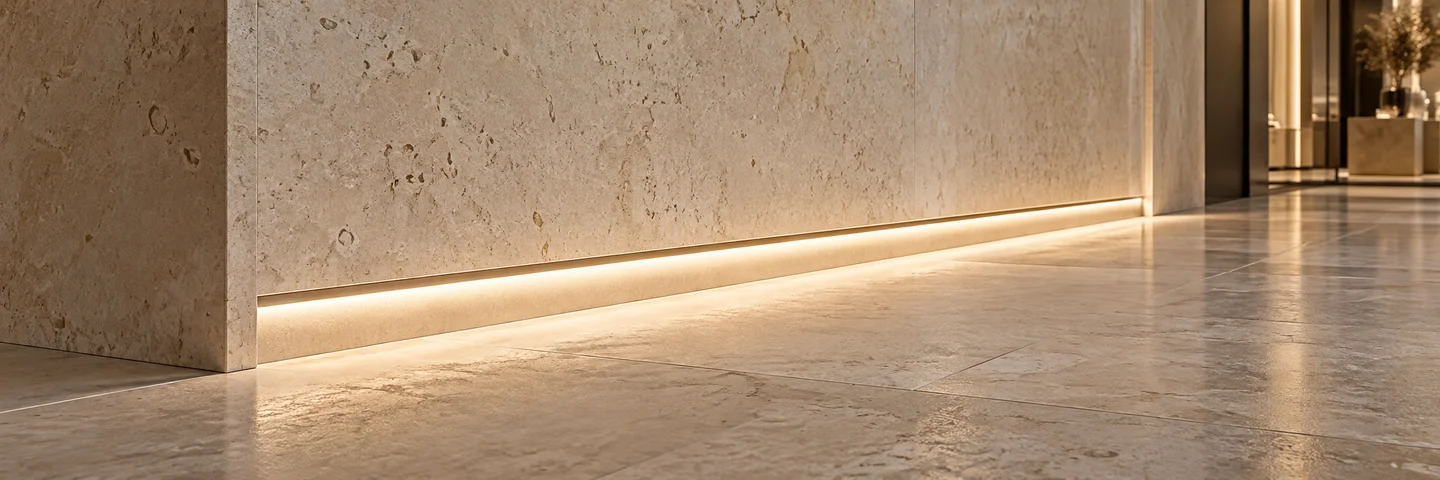
Baseboard LED lighting puts the lighting component into one of the most constrained parts of an interior: the junction between the wall, floor and decorative trim. Before ordering a repeated run, identify which part you need supplied. AlisterTech can review an empty silicone housing, a finished silicone lighting section or a custom profile around your skirting detail. A lighting-component quotation is a different scope from the complete baseboard system.
Send the local section as well as the desired illuminated view. The visible opening, retained body and cable exit must fit together. A rendering communicates the effect; it does not establish a suitable section or the installation clearances.
Decide what the baseboard light should illuminate
An illuminated line facing the room, a downward wash onto the floor and light directed up a wall require different details. Mark the emitting face and the receiving surface on the section. Note the normal viewing positions and the appearance you want at doors, corners and ends.
The direct and indirect lighting comparison helps separate the light path from the mounting arrangement. A recessed line is not automatically indirect lighting. The surrounding return, visible face and source position determine how the assembly will be viewed.
Material transitions matter here. Show where the run meets a doorway, changes wall finish or passes a cabinet. Decide whether the light stops deliberately or continues through a planned join. Do not assume a flexible product can cross every building joint or follow an abrupt corner without a defined transition.
Show the wall-floor interface before choosing the profile
| Detail to provide | What the component review needs to establish |
|---|---|
| Finished opening and recess | Outside fit after decorative finishes and retaining parts are included |
| Light face and sightline | Which surface should be visible and which should remain concealed |
| Supporting surface | How the chosen section will be retained without distortion |
| Doors, corners and ends | Where a return, connection or deliberate break is needed |
| Cable route | How the lead leaves the section and reaches accessible equipment |
| Cleaning and exposure | Which project conditions need review with the complete assembly |
If the opening is fixed, identify that constraint on the drawing. If the skirting is still being developed, state which dimensions can change. The recessed lighting selection guide covers the broader groove and insertion questions; a baseboard adds its own floor-level access and finish requirements.
For industry context, KLUS describes baseboard lighting as a defined architectural arrangement. Its complete profiles and mounting systems are separate products. Their construction, ratings and dimensions do not establish the properties of an AlisterTech silicone component.
Choose the lighting supply that fits the skirting construction
An empty silicone tube or profile is a housing or diffusing body for a separately selected LED strip. Provide the PCB width, component height and connection dimensions so internal fit can be reviewed independently of the outside opening.
A finished LED Neon Flex configuration includes the source as part of the lighting product. Confirm its exact section, emitting face, permitted bend, cut arrangement and ends. Similar outside sizes do not make two lighting configurations interchangeable.
If an available section conflicts with a fixed retention detail or cable interface, send the drawing for custom silicone extrusion review. AlisterTech's published development scope covers geometry, strip clearance, light direction and assembly requirements from drawings or samples. Tooling, samples and the quoted supply format need an agreed basis before production.
Keep the endpoint and replacement route in the sample
A representative sample should include more than a straight illuminated length. Include the most constrained end, corner or cable exit and the surrounding retaining detail. Check the unlit appearance, then the light face and reflections from the intended view.
Ask how the section can be removed or replaced after the skirting and floor finish are complete. Note which part is accessible and whether a connection can be inspected without damaging the surrounding trim. Use the sample approval checklist to keep the selected section, connection and accepted appearance tied to the order.
Floor-level placement does not by itself establish that a product can be stepped on, resist impact or tolerate a particular cleaning process. Describe the actual exposure and request applicable documents for the proposed assembly through Technical Resources. Do not infer complete-system protection from the silicone body alone.
Request a quote for the component you actually need
Send the skirting section, light direction, run schedule, quantities, floor and wall finishes, exposure and destination. Identify who supplies the trim, retaining parts, power equipment and controls. If a strip is already selected, include its exact reference rather than a generic voltage label.
The manufacturing page shows AlisterTech's profile development and assembly context. Ask the quotation to identify the housing or lighting sections, ends and mounting items that are included. Complete skirting, electrical design, site work and installation are separate responsibilities unless explicitly agreed.
Send your baseboard lighting detail before releasing a repeated construction. An approved sample and a clear segment schedule give the product and quotation the same starting point.
Frequently Asked Questions
Does a baseboard LED lighting quotation include the skirting board?
Confirm the scope explicitly. AlisterTech can review the silicone housing or lighting component required for your detail. Do not assume the offer includes a complete metal or decorative baseboard, power equipment or installation.
What should the skirting cross-section show?
Show the finished opening, recess, retained body, visible light face and supporting surface. Include the floor and wall relationship, cable exit, endpoints and any fixed dimensions that cannot change.
Can an existing silicone profile fit a fixed baseboard recess?
An available profile can be reviewed against the measured interface, strip and connection. If it does not fit, custom development may be discussed. The exact geometry and sample requirements must be agreed rather than inferred from a photograph.
Is a silicone light installed near the floor automatically waterproof or walkable?
No. Floor-level location and a silicone housing do not establish those properties. Describe cleaning, moisture, access and mechanical exposure, then review the applicable evidence for the exact completed assembly.
What should I approve before ordering repeated baseboard runs?
Approve a representative section with the real light source, retention, end and cable arrangement. Record the visible result, accepted joints, removal access and individual lengths together with the exact quoted configuration.