
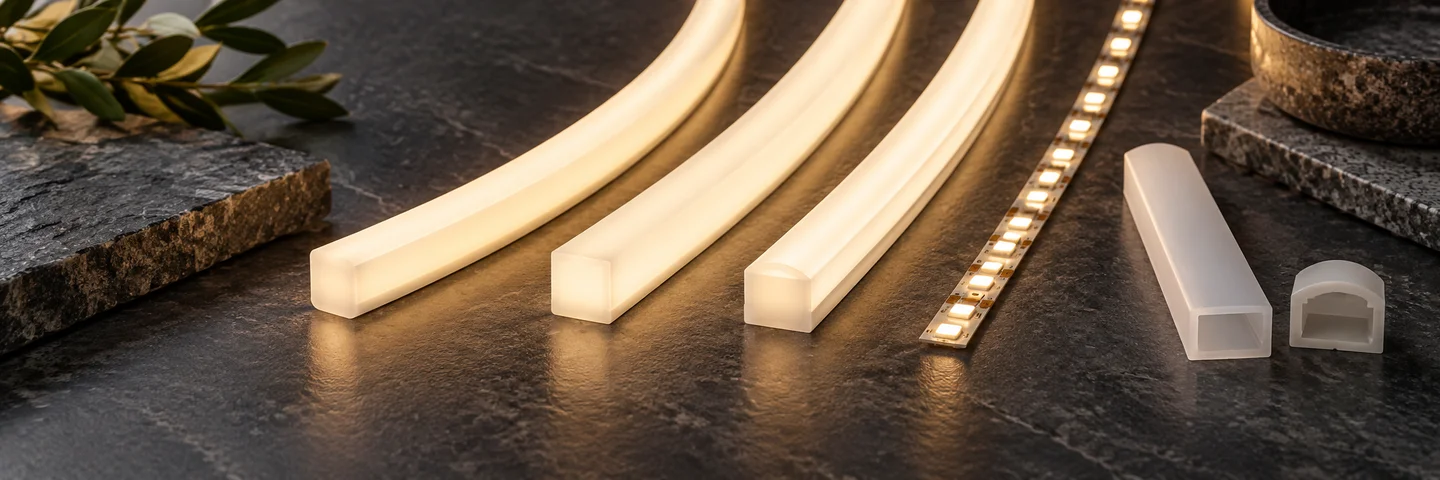
Comparing LED strip brightness becomes useful when each quotation describes the same light source, length and finished assembly. Lumens per metre describe light output; watts per metre describe electrical input. Neither a high LED count nor a high wattage alone tells you how the line will look inside your chosen silicone profile. Ask AlisterTech to review the source, housing and sample requirement together before you approve the supply configuration.
Put three different figures on the comparison sheet
Start with the intended use: a visible decorative line, illumination onto merchandise, or light directed onto a working surface. These need different sample reviews. Total lumens do not, on their own, establish illuminance on a counter or the appearance of a narrow exposed light face.
| Quotation figure | What it describes | What must accompany it |
|---|---|---|
| Lumens per metre, lm/m | Light output per stated length | Exact configuration, colour option and measurement basis |
| Watts per metre, W/m | Electrical input per stated length | Voltage, operating condition and power boundary |
| Lumens per watt, lm/W | Luminous efficacy at that measurement boundary | Light output and input power from the same configuration and conditions |
| Illuminance, lux | Light arriving on a surface | Distance, position and measurement geometry |
Do not mix per-foot and per-metre values or compare one complete reel with one metre of another product. The ENERGY STAR brightness guide explains why light output and wattage are different quantities. For procurement, the next question is which assembled product each figure actually describes.
Ask whether the lumen figure is for the strip or the finished assembly
A bare strip, the same strip inside a silicone diffuser, and a finished LED Neon Flex product are different measurement subjects. A quotation should identify which one its output figure covers. There is no universal percentage that converts a bare-strip value into finished-profile output.
Ask the supplier to identify the LED configuration, silicone section, visible light face, colour option and test conditions attached to a reported value. If data is available only for the bare strip, keep that limitation visible on the comparison sheet. Request assembly-specific information or agree how the sample will be evaluated rather than treating the missing result as a confirmed specification.
For housing selection, compare available silicone tube families against the strip width and component clearance. For a finished light, start with the LED Neon Flex range and confirm the complete configuration. The diffusion guide covers the separate question of visible LED points and light-face appearance.
High density is a layout choice, not a brightness guarantee
A high-density LED strip can place emitters closer together, which may help the visual continuity of a particular assembly. Its LED count does not establish lumens per metre, efficacy or glare performance. Output also depends on the selected LEDs, operating conditions and optical arrangement.
Compare density with the dimensions that matter to your assembly: PCB width, component height, distance to the visible diffuser and permitted operating conditions. A replacement that fits the outside dimensions of the housing may still change the visible line. Use the COB and SMD comparison when deciding between source constructions, then evaluate the selected source in the actual section.
If a quotation substitutes a different source, ask for a revised configuration reference and any affected output, power and colour information. Approving a generic LED package description does not freeze the light appearance of the production supply.
Approve the light in the detail buyers will actually see
For a display or architectural line, give the supplier the viewing position, visible length, nearby materials and surrounding lighting. For light directed onto a surface, provide the working distance and describe the area that needs illumination. Where a formal illuminance or photometric requirement exists, include it in the enquiry and confirm which evidence is available for the proposed product.
AlisterTech's shopping-mall furniture-showroom project followed a buyer's rendering through a physical sample to silicone LED lighting supply. It is a useful example of developing the appearance around a visual brief; the project photographs are not photometric measurements.
For your sample review, keep the source and housing reference fixed, use the intended mounting orientation and review colour and continuity alongside brightness. Check the whole visible length, including ends and connections. Record any agreed viewing or measurement conditions so a later comparison uses the same basis. Where colour rendering matters, add the requirements from the CRI selection guide rather than assuming a brighter strip also renders materials better.
Turn the approved sample into an identifiable supply configuration
An approved sample should lead to a named configuration and a clear scope: LED source, profile section, length, light face, colour requirement, power conditions and end treatment. Record which optical figures are supplied data, which are measured for the assembly and which remain buyer requirements. Do not leave a target value looking like a guaranteed result.
AlisterTech can review an existing profile or a custom silicone section around the available space. Its manufacturing page provides real processing and assembly context. For configuration documents, use Technical Resources; for a proposed supply, send your drawing and sample requirements with the quotation request.
Tell us what the light needs to do, the illuminated lengths and quantities, the available section and your target brightness information. Include an existing approved sample or data sheet if matching a previous installation. This gives us a practical basis to discuss the LED strip source and the finished silicone lighting arrangement.
Frequently Asked Questions
Which lumen-per-metre figure should I compare in LED strip quotations?
Compare values for the same measurement subject and stated conditions. Identify the exact LED configuration, colour option, voltage and length basis, and check whether the figure covers a bare strip or the complete light assembly. Convert units before comparing per-foot and per-metre quotations.
Can a higher-wattage strip produce a dimmer finished light line?
Yes. Wattage describes electrical input, while light output also depends on source efficacy and the finished optical arrangement. Compare documented output for the proposed assemblies and review a sample in the intended installation detail. Do not assume extra power guarantees the desired appearance.
How should bare-strip lumens and finished-assembly output be identified in a quotation?
Label the measurement subject beside the value and identify the relevant configuration and conditions. A bare-strip figure should remain labelled as bare-strip data. If finished-assembly output has not been established, request the available evidence or agree an evaluation requirement before approval.
Which brightness information should appear on the approved configuration?
Record the source and housing references, colour requirement, visible light face, length, power conditions and any agreed optical data or evaluation conditions. Clearly distinguish supplied specifications, measured assembly results and buyer targets so they cannot be confused during production approval.
Does higher LED density always mean a brighter or smoother line?
No. Density is only one part of the source layout. Output and visible continuity depend on the actual LED configuration, spacing, diffuser geometry and viewing conditions. Review the selected strip inside the proposed profile instead of approving brightness or smoothness from LED count alone.