
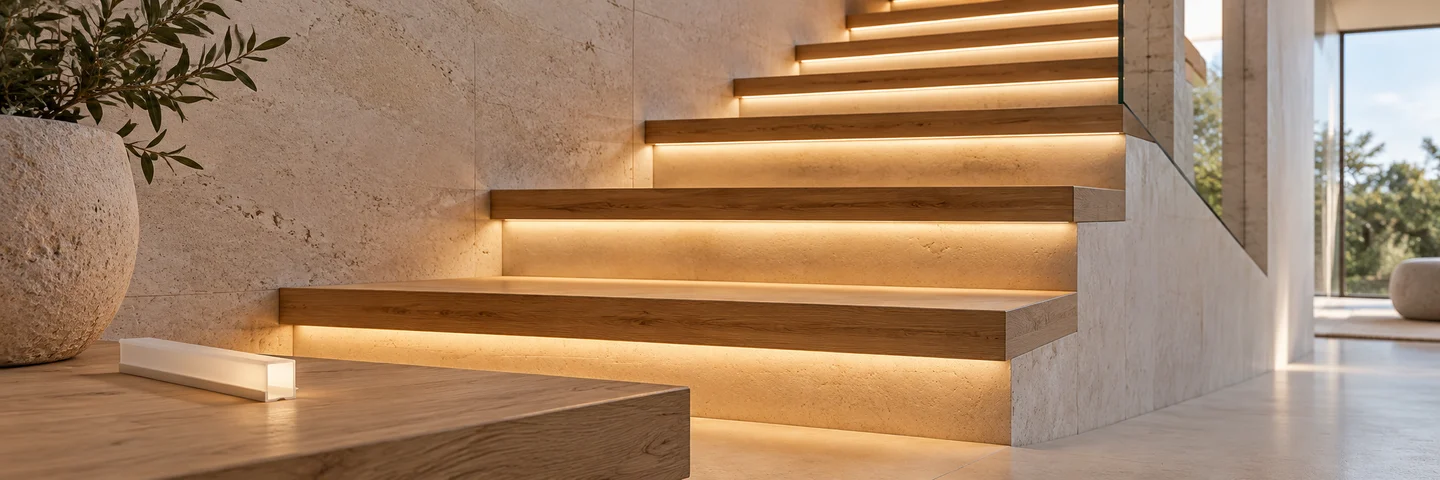
LED strip stair lighting starts with the space beneath or beside the tread. A concealed light face, a repeated section length and a cable route that remains accessible can matter more to the component quotation than the total staircase length. Send AlisterTech the tread section and segment schedule so we can review an existing silicone profile, finished light section or custom extrusion around the detail.
Show where the light sits and who can see it
Identify whether the lighting is under a tread overhang, in a side-wall recess or in another detail defined by the designer. Mark the emitting face and the normal viewing direction from both above and below the flight. This helps the supplier understand whether the user sees an illuminated surface directly or light reflected onto the step.
A rendering communicates the desired effect, but the local section establishes the available width, depth and retaining surface. Show the tread, riser or side structure, finish build-up and any part of the installation that cannot change. The lighting component should be reviewed within that space rather than selected from an outline photograph alone.
This page concerns lighting components for a project-defined detail. Stair structure, slip resistance, required illumination and any emergency-lighting provisions belong in the responsible designer's specification. A silicone light profile does not establish compliance for the staircase.
Prepare a section drawing that resolves the fit
An existing silicone tube may be suitable when its cross-section, source clearance and retention interface fit the recess. If those interfaces need a different shape, ask for a custom silicone extrusion review with the fixed dimensions clearly marked.
| Detail to include | What it allows the supplier to review |
|---|---|
| Recess opening and depth | External profile fit and space around the chosen light source |
| Intended light face | Orientation of the visible line and light directed onto the surrounding detail |
| Strip dimensions | Internal clearance for the PCB, components and connections |
| Retention surface | Mounting interface and space for compatible accessories |
| Section ends and cable route | End-treatment clearance, exit direction and access |
| Exposure and cleaning conditions | Which product and assembly documentation the enquiry needs |
Where the route turns or follows a curved detail, confirm the selected section's permitted bending plane and limits. Do not assume that a profile can bend in every direction because it is flexible. The top-bend and side-bend guide helps frame the review; the actual product limits remain configuration-specific.
Choose between an empty housing and a finished light section
An empty silicone profile is a housing for a separately selected LED strip. It has no powered light output of its own. Send the proposed LED strip reference and dimensions if your team is integrating the source. If you need a light with the source included, ask about the relevant LED Neon Flex configuration and identify the required ends and connections.
The enquiry should also state who supplies the driver, controller, sensors and site wiring. A sequence of illuminated steps does not mean a motion-control system is part of the lighting-component quotation. If such equipment is already selected, include its full references and the desired operating behaviour for a compatibility review by the responsible suppliers.
For a recessed installation, agree how the lighting section can be accessed or replaced after surrounding finishes are complete. Use the mounting clips and adhesive comparison to identify retention questions, then request accessories that match the actual section. A similarly sized clip or end cap is not automatically compatible.
Order repeated segments as a clear supply schedule
Stair projects often repeat a short lighting section many times. List each segment's illuminated length, quantity, location reference, end treatment and cable exit. Separate different lengths or connection directions into different rows, even when they share the same profile.
For example, a buyer may have straight-flight sections, shorter return sections and a different connection at the landing. Those are useful schedule categories, not assumed standard products. Keep the final dimensions and cut units tied to the approved configuration. The custom-length cut-list guide provides the wider purchasing checklist.
AlisterTech's manufacturing information includes profile processing and handling of supplied formats. Connecting that capability to an identified section schedule helps define what is actually needed for your order.
Ask which lengths, labels and connections can be included in the offer. Confirm any allowance around the illuminated section and its ends before the order is released. Do not shorten an electrical product at an arbitrary position to make an undefined recess fit.
Review one representative detail before the repeated supply
A useful sample brings the proposed profile, source, end treatment and retaining interface into a representative tread or recess mock-up. Check the intended viewing directions, light-face appearance, fit at the ends and access to the connection. Keep the agreed sample linked to the drawing and section schedule.
If the installation will face moisture, cleaning liquids or outdoor exposure, describe the actual conditions and request the relevant assembly evidence. The IP-rating guide explains why a material name or one protected component does not establish the rating of the whole installation.
For the surrounding architectural plan, see linear-lighting project preparation. AlisterTech can discuss the profile and lighting supply against your dimensions; it does not replace the project's structural, electrical or lighting design responsibilities. Request the available configuration documents through Technical Resources.
Request a stair-lighting component quotation
Send the local section, overall route, segment lengths and quantities, source information if selected, retention method, cable exits and installation environment. Include the destination and identify any equipment you will provide. If your brief is still a rendering, add the dimensions that must remain fixed so the section can be discussed around them.
Submit your stair-lighting drawing for an existing-profile or custom-section discussion. The quotation should identify the silicone housing or finished light supplied, its accessories and connections, the sample scope and any items requiring separate confirmation.
Frequently Asked Questions
Which dimensions matter when a light line sits beneath a stair tread?
Provide the recess opening and depth, tread overhang or surrounding detail, intended light face, strip dimensions and space for ends and cables. Include the retaining surface and viewing direction so fit and visible appearance can be reviewed together.
Should a stair project use an empty silicone housing or finished Neon Flex?
Choose an empty housing when the LED source is being selected and integrated separately. Request a finished LED Neon Flex configuration when the light source needs to be included in the supplied section. Confirm the exact source, ends and connections in either assembly brief.
How should repeated stair-lighting segments and cable exits be scheduled?
Use separate rows for different illuminated lengths, end treatments or cable directions. Add quantity and location references for each row. Match the final cut units and dimensions to the approved configuration rather than specifying only a total number of metres.
Does ordering lighting components include sensors and site installation?
Only when the written quotation explicitly includes those items. Identify the lighting sections, accessories and connections requested, and separately state who provides sensors, drivers, controls and site work. The visual effect of a staircase does not establish the equipment supplied.
Can the silicone profile serve as a load-bearing or anti-slip stair edge?
Do not assume that role from a lighting-profile description. The stair structure, exposed edge and any slip-resistance or safety requirements need their own specified products and design review. Ask AlisterTech to review the silicone lighting component within the installation detail defined by your project team.