
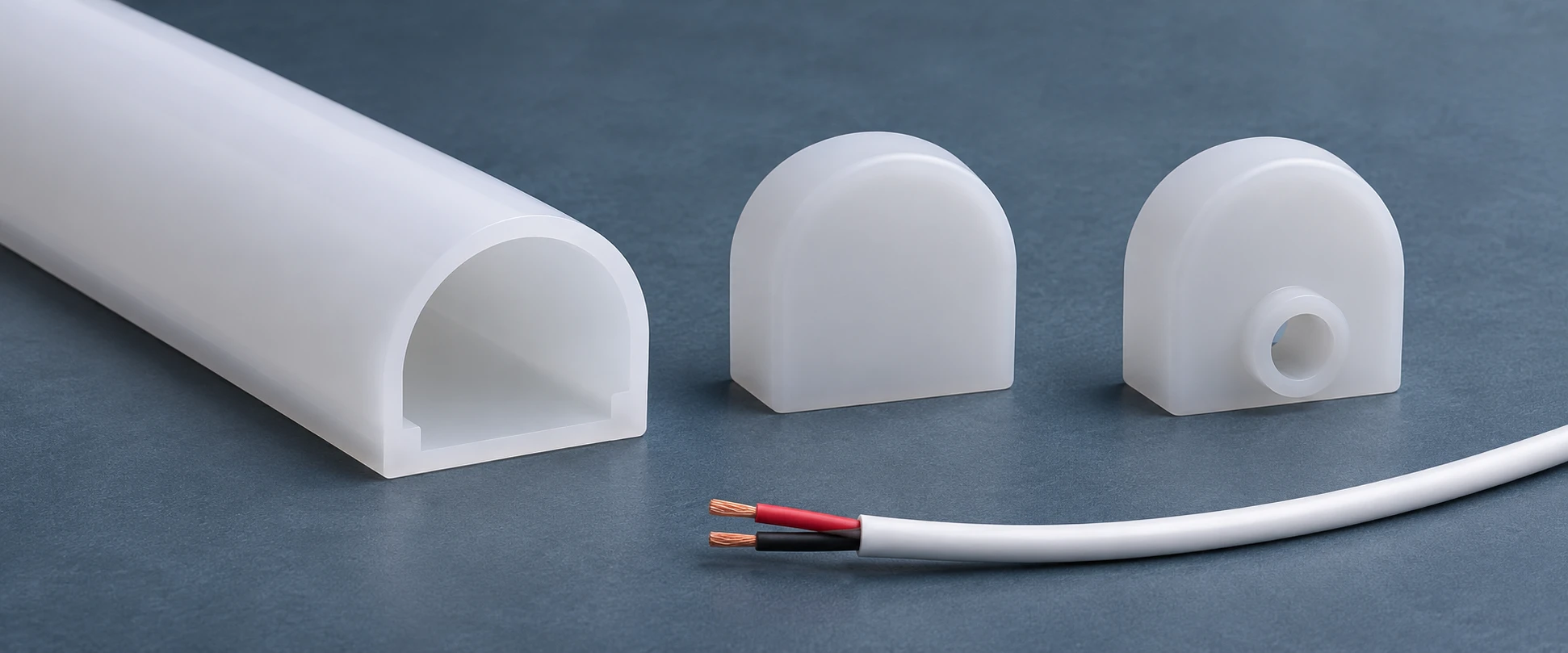
Silicone tube end caps for LED lighting should be ordered against the actual end of the housing. Start with the profile reference and a straight-on photograph of its opening. Then decide which end closes and which end needs a cable exit. A nominal profile size on its own leaves both decisions unresolved.
Count the Ends on Your Schedule
An installation drawing often shows the lit lengths without identifying how each length finishes. Add a line for each supplied section and describe both ends. A closed cap on one side and a cable-exit cap on the other are two separate order items when they use different parts.
| At the end of the section | Put on the order schedule |
|---|---|
| No cable leaves this end | Closed-end requirement and the actual mating profile |
| A lead exits the housing | Cable reference, exit direction and clearance around the lead |
| The end meets another part | A section view of the interface and the required access |
| You are replacing an existing cap | The original part or drawing and photos of both mating faces |
If the same profile appears in several locations, keep the end treatment tied to each location. A photograph of one finished length may be useful for appearance while leaving the other end undefined.
Find the Catalogue Reference Before Checking Fit
Use the K15 end cap entry and K15 domed tube reference to start a K15 enquiry. The K13 entry, D22 entry and P10030 entry are separate catalogue references. Send the mating profile and the intended end treatment when requesting any of these items.
Ask which surface controls the fit. An outside envelope, the opening of a cap and the part of the profile it grips describe different interfaces. Use the applicable drawing or sample to confirm fit, insertion and cable clearance. A similar model name does not make the parts interchangeable.
Identify the Assembly You Are Ordering
If you are buying an empty silicone tube, tell the supplier which strip and lead will go inside it. If you are buying finished LED Neon Flex, request the proposed end arrangement for that exact configuration. See the finished-light connection guide when the order includes a powered light and its terminations.
Where a fixed opening or cable route requires a different housing section, send a dimensioned sketch to custom silicone extrusion. Define the proposed cap and cable interface alongside the housing so the parts can be reviewed together.
Put the Sample Reference on the Purchase Order
AlisterTech can review the requested profile, accessories and cable exit against your drawings or physical sample. The manufacturing page shows the assembly context and the technical resources provide a starting point for product documentation.
For the first sample, confirm what arrives and which cap goes on each end. Check that the assembled end sits as intended, that the lead follows the required route and that the joint can be accessed where needed. If the application calls for a documented environmental rating, request the applicable evidence for the completed assembly.
For repeat orders, send the approved part reference, profile revision and quantities split by closed and cable-exit ends. Ask the quotation to identify which accessories and assembly work are included.
Frequently Asked Questions
Are silicone tube end caps interchangeable?
Match the part to the catalogue reference and the actual mating section. Confirm the interface and cable clearance for the intended assembly.
What is the difference between a closed cap and a cable-exit cap?
A closed cap finishes an end with no exiting lead. A cable-exit cap must also accommodate the selected cable and its intended direction.
How do I ask for a K15 silicone end cap?
Send the K15 reference, a clear view of the actual mating profile and the required end treatment. Ask the quotation to identify the proposed cap and any fit check still needed.
Does fitting an end cap establish an IP rating?
The applicable rating needs evidence for the completed assembly, including the selected end treatment and connections.
What should I send for an end cap quotation?
Send the profile model or section drawing, both end views, cable reference and exit direction, installation conditions and quantities by cap type.