
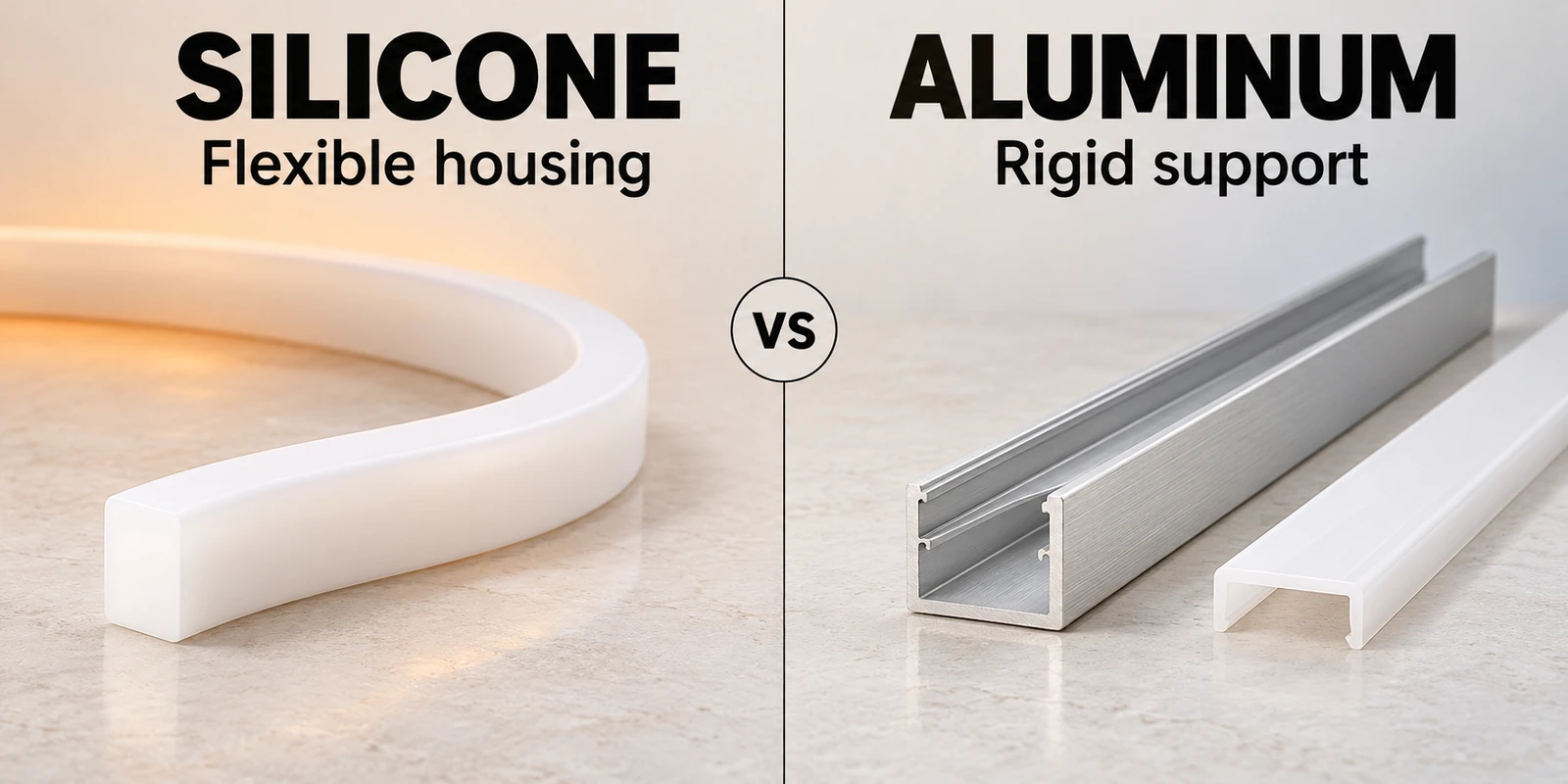
A silicone LED diffuser and an aluminum LED channel solve different parts of a lighting installation. The silicone format provides a flexible housing or light-facing surface; an aluminum channel provides a defined mounting structure and may support heat dissipation as part of the selected system. Neither is a universal replacement for the other. Start with the strip, section, mounting route and intended light appearance.
AlisterTech’s part in this comparison is the silicone housing and, where requested, the silicone lighting assembly. Start with our silicone tube and profile formats if you already have a mounting structure. Where the interface needs another shape, a custom section can be discussed from your drawing. Bring the proposed channel or recess dimensions so fit, retention and light appearance can be considered together.
Compare the Complete Construction
| Decision | Silicone housing or diffuser | Aluminum channel system |
|---|---|---|
| Profile form | Flexible outside section and internal strip space | Supporting channel with a matching cover where specified |
| Mounting | Retention must suit the selected flexible section | Surface, recessed or corner detail depends on the channel |
| Curved route | Check permitted bending plane and strip limits | Do not assume a rigid channel follows a curve |
| Light appearance | Depends on emitting surface, strip position and viewing distance | Depends on cover, source position and viewing distance |
| Heat management | Not a substitute for a designed thermal arrangement | Review strip contact, channel design and the complete installation |
| End details | Match caps, cable exits and support to the section | Match cover, end caps and mounting hardware to the channel |
Browse silicone tube families for an empty housing around a separately selected strip. A finished LED Neon Flex product includes an integrated light source and needs its exact electrical configuration reviewed separately. Identify any separately supplied mounting channel in your enquiry.

Check the Inside Space, Not Just Outside Width
Give the supplier PCB width, maximum component height and any joints that must pass through the housing. Describe insertion or assembly access and the space at the ends. A broad visible face does not establish usable internal clearance. Use the strip-to-profile fit guide before selecting a sample.
For an architectural recess, also provide the surrounding groove width and depth, support material and service access. If the silicone section cannot fit a fixed interface, request custom silicone extrusion rather than forcing an unsuitable existing format.

Review Diffusion and Heat as Separate Decisions
A smooth light line depends on the actual source and optical arrangement. Review a powered representative sample from the normal viewing position; do not infer a spotless effect from material name alone. The diffusion guide explains the source-to-surface relationship.
For thermal planning, check the selected strip and mounting system. Silicone appearance does not establish a heat-dissipation path, while an aluminum shape alone does not prove suitability for every strip load or enclosed recess. Review LED strip heat dissipation with the complete mounting detail. No universal temperature limit or performance gain is claimed here.
Prepare a Sample and Quotation Brief
Send the section, strip specification, visible light face, route and quantity. Explain whether the requirement is housing only or a finished assembly, and identify cable exits and end support. Request a sample that represents the critical fit and light appearance. Similar-looking clips or caps do not establish compatibility or an environmental rating.
AlisterTech's Manufacturing information describes development and production against an approved basis. Technical Resources provides supporting product files. Use Contact or RFQ to discuss the silicone profile scope rather than an assumed interchangeable channel.
Reference Context
Waveform Lighting describes a product-specific aluminum mounting system. Its dimensions and compatible accessories are not specifications for AlisterTech silicone profiles.
Frequently Asked Questions
Can a silicone LED diffuser replace every aluminum channel?
No. Check mounting, internal fit, light appearance and thermal requirements. Flexible housing and a supporting channel are different constructions.
Does a silicone tube include an LED strip?
An empty silicone tube does not include the light source. Finished LED Neon Flex is a different supply format with an integrated source.
Does silicone housing replace heat dissipation?
Do not assume it does. Review the strip, support and complete thermal arrangement for the installation.
What should I send to compare profile options?
Send the strip dimensions, available installation section, mounting interface and required light appearance. State whether you need an empty silicone housing or finished lighting, and identify any separately supplied channel. Use the strip-to-profile fit guide to describe the internal opening and component clearance before discussing an existing or custom section.
Find the Silicone Section for Your Mounting Structure
Send the strip envelope and a section of the channel or recess. Tell us whether you need an empty housing or a lighting assembly, plus the visible light face and quantity.
Application illustration.