
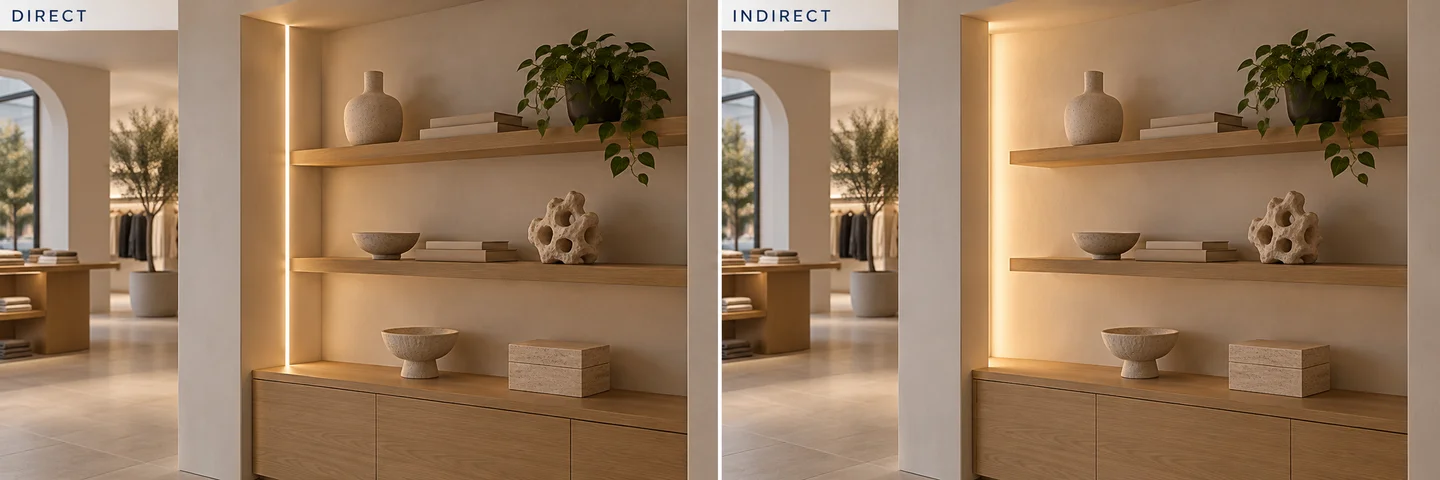
Direct vs indirect lighting is a purchasing decision about what the light should illuminate and how the assembly fits the detail. Direct light reaches the intended surface without first using a room surface as a reflector. Indirect light reaches the space after reflecting from a wall, ceiling or another receiving surface. For a silicone lighting enquiry, show that path on a section drawing rather than sending only a mood image.
AlisterTech can review the silicone profile or lighting section behind the effect. The useful starting point is the visible light face, available installation space and exact source, followed by a sample in representative surroundings. A brighter strip alone cannot resolve a misplaced light face or an unsuitable recess.
Start with the light path, not the mounting label
An exposed luminous line can be a direct visual feature. A source concealed behind a return can produce an indirect wash. These are useful architectural examples, but visibility alone does not define the distinction: a shielded or diffused light can still send light directly toward the intended surface. Direct also does not necessarily mean a narrow spotlight.
ERCO's explanation of directional light distinguishes focused directional light as a form of direct lighting. That distinction matters when a buyer asks for a flexible luminous line rather than an accent spotlight. Select the source and profile for the desired assembly instead of treating all direct light as one product type.
Likewise, recessed and surface-mounted describe physical mounting, not whether the result is direct or indirect. A recessed line facing into the room is different from a concealed strip lighting the back of a cove. If mounting is still undecided, see the recessed LED strip lighting selection guide.
Compare the detail you need to order
| Buyer question | Direct lighting detail | Indirect lighting detail |
|---|---|---|
| What should the light reach? | The intended object, work area or visible line | A receiving surface that reflects light into the space |
| What needs approval? | Emitting face, direction, visible points and viewing comfort | Source concealment, surface appearance and reflected wash |
| What belongs in the section? | Profile position, aperture and viewing positions | Source position, shielding return and receiving surface |
| What can change the result? | Diffuser, source layout, orientation and surroundings | Surface colour, finish, geometry and source placement |
| What should the sample include? | The actual luminous section and intended view | The proposed light inside a representative reflecting detail |
These are selection questions, not a promise that one arrangement is always brighter, more efficient or free of glare. For the same project, compare the actual light requirement and arrangement. A photograph of a soft wash does not establish task illuminance, energy use or compliance.
Specify an exposed line as a finished visible product
When the line itself is in view, the unlit body is part of the design. Show whether a flat face, curved face or round contour should be visible and how it meets the surrounding material. Identify normal viewing positions, nearby reflective finishes, joints and endpoints.
LED Neon Flex is a finished lighting route with an integrated source. An empty silicone tube is a different purchase: your team must identify the separate strip and its fit. The external shape alone does not establish an optical beam angle or a permitted bend direction.
Review the actual source inside the proposed section for point visibility and the appearance of ends and joins. The diffusion guide addresses that relationship; the brightness comparison explains why input watts alone cannot describe the finished line.
Specify an indirect wash with its receiving surface
For a concealed wash, include the return or lip that hides the source and the surface it should illuminate. Send the surface finish or a representative sample where possible. A change from pale plaster to dark timber, or from a matte finish to a reflective one, changes the context in which the light must be evaluated.
There is no universal strip-to-wall spacing or power value for every cove. The section, source and desired appearance need review together. The cove installation guide deals with the concealed construction in more detail. Keep access to ends, cables and separately selected equipment in that drawing.
If the required position conflicts with an available housing, send the fixed interface for custom silicone extrusion review. A profile change can address geometry; it should not be treated as proof of a particular room-lighting result without a representative sample and the necessary project evaluation.
Move from a rendering to a sample you can approve
The real shopping-mall furniture showroom project illustrates AlisterTech's confirmed supply process: the customer provided a rendering, AlisterTech made a physical sample and supplied silicone LED strip lighting. It demonstrates a route from visual intent to a supplied product. It is not evidence that every lighting effect, suspension system or installation service is included.
For your own comparison, keep the intended source reference and surrounding materials consistent. View the sample from the occupied positions, including reflections. Agree what will be accepted at corners, joins and cable exits, and record any deliberate dark break. The sample approval checklist can support that review.
AlisterTech's manufacturing information covers profile development, tooling, sampling and assembly scope. Use it to discuss the component you need; ask separately which project-specific documents are available through Technical Resources.
Request the lighting component behind your design
A useful enquiry includes an elevation or rendering, a local section, the intended light path, visible face, surrounding finish, run lengths, quantity and destination. Add the exact strip and power/control references if already chosen. State whether AlisterTech should quote a housing only, finished lighting sections or development of a new silicone section.
The building detail, lighting calculations, power equipment and site work need clear responsibilities. If those are handled by your designer or installer, identify that in the request. Send the section and desired effect so the quotation can address the silicone lighting supply rather than an undefined complete-room package.
Frequently Asked Questions
What is the difference between direct and indirect lighting?
Direct light reaches the intended surface without first reflecting from a room surface. Indirect light uses a wall, ceiling or other receiving surface as a reflector before lighting the space. Show the intended path in the installation section.
Does a recessed LED strip always provide indirect lighting?
No. Recessed describes where the assembly sits. A recessed line can face directly into the space, while a concealed strip can illuminate a separate reflecting surface. Mounting position and light path are separate decisions.
Is indirect lighting always brighter or more energy efficient?
No universal result follows from that label. Compare the required illumination, actual source, receiving surface and geometry. A soft-looking image or a higher wattage does not establish the delivered light or energy performance.
Can a silicone diffuser be used for a visible direct light line?
A silicone profile or finished light can be reviewed for that purpose when its geometry, source and visible face suit the detail. Approve the actual sample from the intended view. An empty diffuser still requires a separately selected LED strip.
What should I send AlisterTech for a direct or indirect lighting quotation?
Send the desired effect and section drawing, light direction, surrounding finishes, available space, lengths, quantity and installation environment. Identify the source and equipment already selected and whether the requested supply is an empty profile, finished lighting or a custom section.